Showing posts with label sheep. Show all posts

Friday, May 22, 2015

Colors and Patterns in Finnsheep


Finn sheep have the potential for several different color variations. These colors are buried deep in the genes of the sheep - both the ewes and the rams. White is probably the most common color found in Finn sheep, but there are other natural solid colors and variegated shades that show up in characteristic patterns. Finn sheep are genetically part of a group of sheep called the Northern Short-Tailed breeds. So they typically exhibit the same patterns and colors as the Shetland and Icelandic breeds. I cannot even try to explain color genetics. Detailed information is found on the International Finnsheep Breeders Registry. I simply offer the following short explanation of why our Finn sheep look the way they do. There are basically two factors at work to determine what we see: color and pattern.

We have two white Finn ewes. White is the dominate color for Finn sheep. To be called white, the fleece must be white and the skin and tongue pink. These fleeces are prized because they allow one to use dye without worrying about the presence of other natural color. But we also love the beautifully natural colors of our remaining ewes and rams.

Colored sheep are always genetically either black or brown. Black is dominant and brown recessive. Black lambs present black wool, with black skin and tongue and black hair on their face and legs. Brown lambs have brown wool and a dark reddish/brown tongue and skin. The hair on their face and legs is also brown.

A lamb could also present a "dilute" pattern, meaning that its solid black or brown colored fleece might become more pale as it grows, fading from black to grey or from brown to fawn as the new wool emerges.

Finn sheep have a couple of common patterns and markings. The badgerface marking exhibits badger "stripes" along either side of the face. The jaw, throat, chest, belly and legs and the inside of their ears will be dark colored as well - black if they are colored black and brown if they are brown. The fleece will be usually be a light to medium variegated color.

The HST pattern (head, socks, tail) shows white markings such as lines, stripes, stars, spots, patches, or a blaze on the head, legs and/or feet, and tail. Our little black rams, born this year, are HST. Their little tails and feet look like they were dipped in white paint! Usually the white marking appears on all three spots (HST) or in some combination. These sheep are considered solid colored sheep but with the HST marking.

A "piebald" marking is more rare and is not actually a pattern since it can occur in either color and with other patterns. It will not appear in a true white sheep. Pie-bald exhibits irregular white spots in the fleece section of the body of the sheep. The spots could be large, even very large. Our all white ram has one small spot on his rear hip. This means that he is actually a "black" sheep with an enormous white patch! What is unique about the pie-bald is that the white colored wool grows from pink skin and the colored wool from colored skin. It is a recessive marking, meaning that both the ram and the ewe must carry the gene in order for the resulting lamb to exhibit the marking.

Pheomelanin is the presence of a peach or tan color in a newborn Finn lamb. This color is often found in the hair on the legs or face of the lamb. It isn't actually genetic color, but rather a pigmentation that is usually gone by about six months. Our little white lambs, born to Nutmeg this year, have this coloring on their legs.

The patterns and colors of our colored Finn sheep are fascinating. Color genetics and breeding for color and pattern can be quite complicated. I leave all of those decisions to Kerry and just happily wait to see what appears when the lambs are born.


Monday, May 18, 2015

More Babies


We just love new babies! These triplets belong to Star, who gives us triplets pretty consistently. They were all vigorous and healthy and were up and nursing right away. The little spotted white one is a ewe lamb and the other two are ram lambs.


Wednesday, May 6, 2015

New Babies


This is our Bella with her new lambs. She had twins this year, a little ewe lamb and a ram lamb. They are both white with no other color to speak of. At least not yet. They are darling little things and strong and vigorous. Abigail is holding Bella just before she gave birth. You can see what a lovely udder Bella has made. Lots of milk for these two.


This is Nutmeg and her new babies. She also had twins. A mostly white ram lamb with light brown color on his legs and a mostly white ewe lamb, with some color on her legs and a large brown spot encompassing her left ear. These lambs were also born strong and healthy, thank goodness.


Friday, April 24, 2015

Late Spring Nutrition for Sheep


Late spring is the hardest nutritional time of year for sheep. Even though it is a little warmer, there is still little nutrition on the landscape. Plants from last year are bleached of nutrients and this year's growth is yet in its earliest stages. High elevation landscapes are still cold, windy and dry, further retarding new plant growth. This leaves our sheep still relying heavily on stored nutrients and stored energy from last year. The situation for the ewes is further complicated by pregnancy. So feeding has to be done carefully.

Over conditioning ewes with too much nutrition and too much fat, can result in metabolic disorders during the final phases of pregnancy. As a sheep shearer, I see many a backyard sheep that is too fat. However, too little conditioning before lambing leaves a ewe with not enough milk to nurse the new-born lambs. So proper feeding is heavily dependent on the ability of the flockmaster to evaluate and judge the condition of the sheep, especially ewes.

The best way to get ewes in condition for lambing is to supplement their forage with a concentrate, such as corn or a mixed grain. The supplemental grain has a high level of phosphorous and energy. The pregnant ewes need an adequate amount of fat cover without being overly fat. At the time of lambing, the ewe's body will be called on to abruptly provide an increased amount of calcium into her milk supply as the new lambs begin to nurse. That amount of calcium will be on an increasing plane as the lambs grow. At some weeks prior to the time of lambing, flockmasters should begin to provide forage with high levels of calcium. So, reducing the grain and, at the same time, increasing the amount of green forage, such as good quality hay, will make an increasing amount of calcium available. If there is fresh green grass in the pasture, this is also highly nutritious and rich in calcium.

After the lambs are born and nursing, and ewes are back to normal feeding, adequate amounts of energy again become important. A diet rich in energy, protein and calcium is important. Flockmasters need to provide an adequate amount of green forage, especially leafy forage, if it is available. The ewe diet can again be supplemented with a concentrate such as grain to boost energy during lactation.

We choose to lamb later in the spring with the hopes that we will have had some rain to begin the new growth on our landscape. This growth really benefits the new lambs and the mothers. On a dry year, we don't see green grass until June. On a windy year, any new grass is dessicated. These challenges make a good supply of green hay important to find, even though the weather is warm and the sun is shining. We had a bit of early green up, but with no rain yet, this early grass has begun to dry out. While we anxiously await our lambing this year, we're praying for rain.

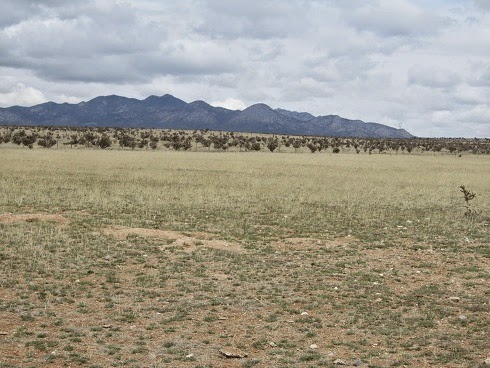
You can see that our spring forage isn't very good yet!

A treat once in a while, given by Abigail, doesn't hurt either!